
Hyundai Tucson: Engine Control System / Electric EGR Control Valve
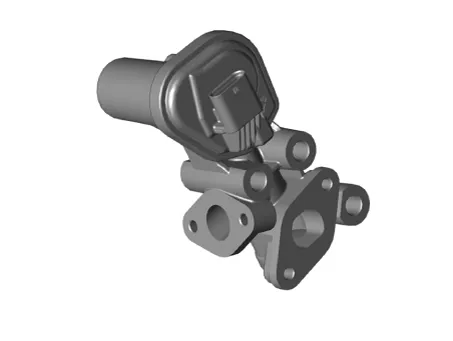
| Item | Specification |
| Coil Resistance (Ω) | 2.21 - 2.99 [20°C (68°F)] |
| Item | Specification |
| Supply Voltage (V) | 5 |
| Opened Voltage (V) | 0.7 - 1.25 |
| Closed Voltage (V) | 3.85 - 4.15 |
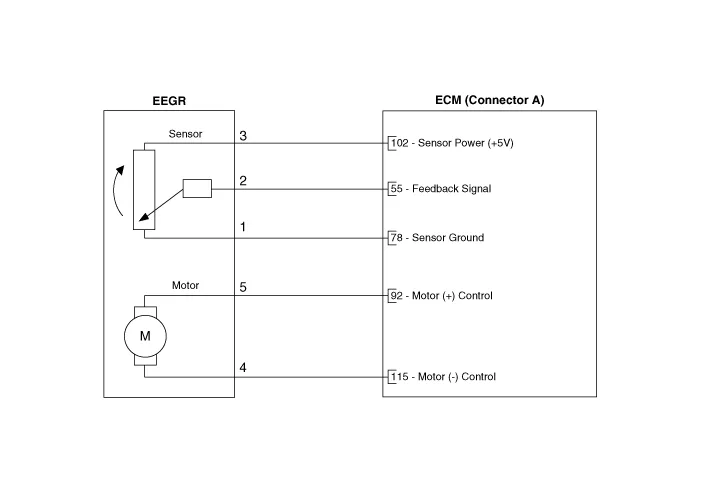
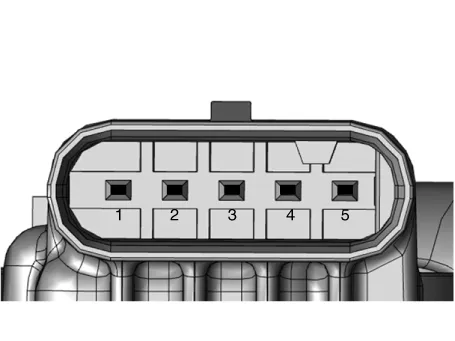
1.In the engine control system, failure can be quickly diagnosed by using the diagnosis tool.
(1)Self diagnosis : Checking failure and code number (DTC).
(2)Current data : Checking the system input/output data state.
(3)Actuation test : Checking the system operation condition.
(4)Additional function : Controlling other features including system option setting and zero point adjustment.
[Motor]
1.Turn the ignition switch OFF.
2.Disconnect the EEGR valve connector.
3.Check that the EEGR valve is stuck by foreign material.
4.Measure resistance between motor 4 and 5 control terminals of the motor.
5.Check that the resistance is within the specification.
Specification : Refer to Specification
[Feedback Position Sensor]
1.Connect the diagnostic tool to the data link connector.
2.Perform the fully open and the fully closing operation of the EEGR valve by using the actuation test.
3.Check that the voltage is within the specification.
Specification : Refer to Specification
1.Remove the EGR cooler.(Refer to Engine Mechanical System - "EGR Cooler")
2.Disconnect the EEGR control valve connector (A).
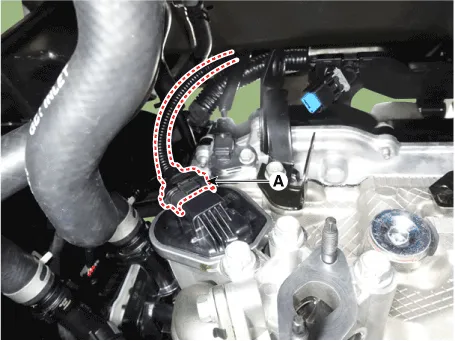
3.Loosen the EEGR pipe mounting bolt (A).
Tightening Torque :18.6 - 23.5 N.m (1.9 - 2.4 kgf.m, 13.7 - 17.4 lb-ft)
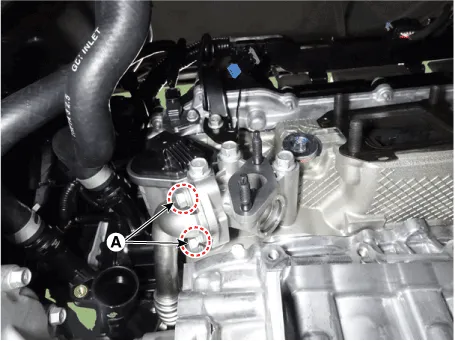
4.Remove the EEGR valve (A) after loosening the mounting bolt.
Tightening Torque :52.0 - 57.9 N.m (5.3 - 5.9 kgf.m, 38.3 - 42.7 lb-ft)
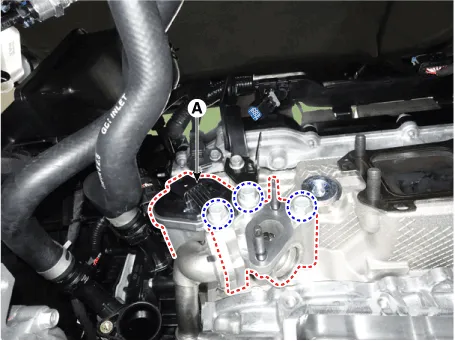

• Install the component with the specified torques.
• Note that internal damage may occur when the component is dropped. In this case, use it after inspecting.

• Be careful of foreign material not to flow into the valve.
1.Install in the reverse order of removal.
 Canister Close Valve (CCV)
- Description
Canister Close Valve (CCV) is normally open and is installed on the
canister ventilation line. It seals evaporative emission control system
by shutting the canister from the atmos ...
 Oil Temperature Sensor (OTS)
- Description
Continuous Variable Valve Timing (CVVT) system advances or retards the
valve timing of the intake and exhaust valve in accordance with the ECM
control signal which is calculated b ...
Other information:
Hyundai Tucson (NX4) 2022-2026 Service Manual: Accelerator Pedal
- Removal
1.Turn the ignition switch OFF and disconnect the battery (-) terminal.
2.Disconnect the accelerator position snesor connector (A).
3.Remove the upper mounting cap (B) and the loosen the mounting nut (C).
4.Remove the lower mounting cap (D) and the loosen the mounting bolt (E).Ti ...
Hyundai Tucson (NX4) 2022-2026 Owner's Manual: Smart Cruise Control disabled
If the front radar is covered or blocked,
its detecting performance is reduced,
and Smart Cruise Control is temporarily
limited or disabled.
The "Smart Cruise Control disabled. Radar
blocked" warning message may appear
on the instrument cluster.
If Smart Cruise Control does not operate ...
