
Hyundai Tucson: Engine Control System / Variable Intake Solenoid (VIS) Valve
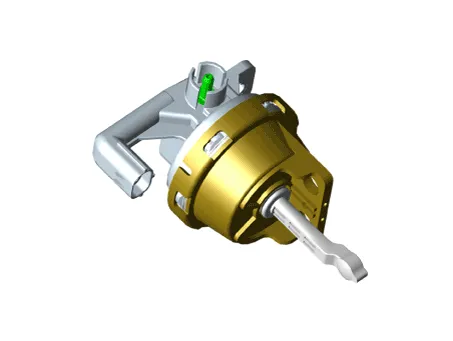
| Engine Condition | VIS Valve | Operation |
| Medium speed | Closed | Increasing engine performance in low engine speed by reducing intake interference among cylinders |
| Low / High speed | Open | Minimizing intake resistance by shortening intake manifold length and increasing area of air entrance |
| Item | Specification |
| Coil resistance (Ω) | 30.0 - 35.0 [22°C (71.6°F)] |
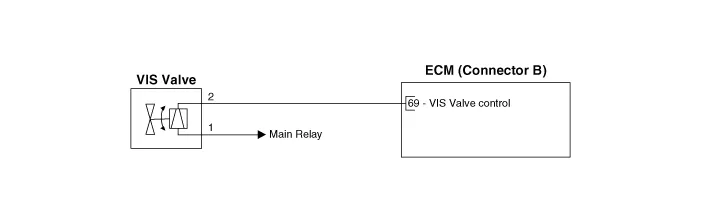
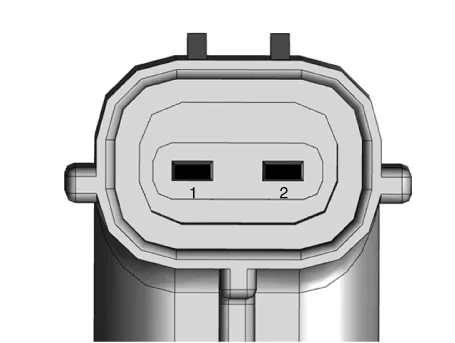
1.Turn the ignition switch OFF.
2.Disconnect the VIS valve connector.
3.Measure resistance between VIS valve terminals 1 and 2.
Specification : Refer to "Specification"
1.Turn the ignition switch OFF and disconnect the battery negative (-) cable.
2.Disconnect the VIS valve connector (A).
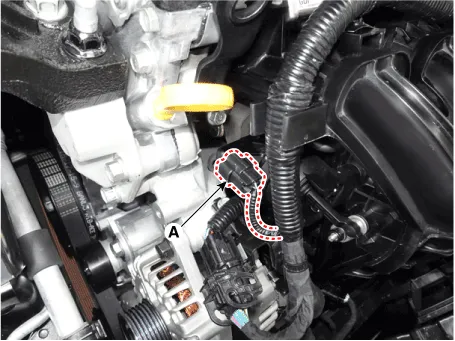
3.Disconnect the hose (A) and then remove the VIS valve (B).
Tightening Torque :9.8 - 11.8 N.m (1.0 - 1.2 kgf.m, 7.2 - 8.7 lb-ft)
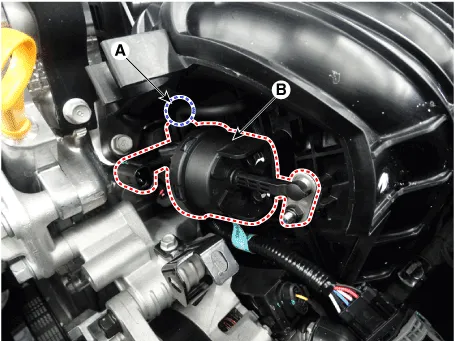

• Install the component with the specified torques.
• Note that internal damage may occur when the component is dropped. In this case, use it after inspecting.

• Be careful of foreign material not to flow into the valve.
1.Install in the reverse order of removal.
 Variable Force Solenoid (VFS)
- Description
CVVT (Continuous Variable Valve Timing) system advances or retards the
valve opening and closing timing of the intake or the exhaust valve in
accordance with the ECM control, calc ...
 E-CVVT Motor
- Description
E- CVVT (Electric Continuous Variable Valve Timing) system, located on
the intake camshaft of the engine, uses motor rotation to control the
rotation angle of camshaft relative to ...
Other information:
Hyundai Tucson (NX4) 2022-2026 Service Manual: Rear Brake Caliper
- Components
1. EPB Actuator2. Caliper body3. Caliper carrier4. Pad retainer5. Brake pad
- Removal
• Be careful not to damage the parts located under the vehicle
(floor under cover, fuel filter, fuel tank and canister) when raising
the vehicle using the lift.(R ...
Hyundai Tucson (NX4) 2022-2026 Service Manual: Mode Control Actuator
- Description
The mode control actuator is located at the heater unit.It adjusts the
position of the mode door by operating the mode control actuator based
on the signal of the A/C control unit. Pressing the mode select switch
makes the mode control actuator shift in order of Vent → Bi-Le ...
