
Hyundai Tucson: Seats / Head Restraints
The vehicle’s front and rear seats have adjustable head restraints. The head restraints are designed to help protect passengers from whiplash and other neck and spinal injuries during a collision, especially a rear impact collision. When there are no occupants in the rear seats, adjust the rear head restraints to the lowest height to improve the driver's visibility.
WARNING
To help reduce, the risk of serious injury or death in an accident, take the following precautions when adjusting your head restraints:
- Always adjust the head restraints properly for all passengers BEFORE starting the vehicle.
- Never let anyone ride in a seat with the head restraints removed or reversed.
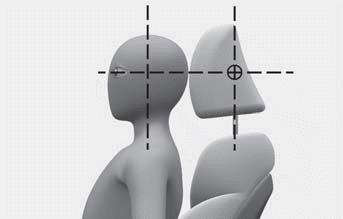
- Adjust the head restraints so that the middle of the head restraint is at the same height as the top of the eyes.
- Never adjust the driver's head restraint when the vehicle is moving.
- Make sure the head restraint is locked in place after adjustment.
WARNING
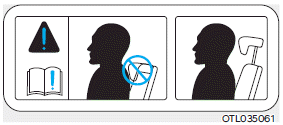
When passengers are sitting on the rear seats, always raise the head restraints above the lowest stored position.
Front seat head restraints
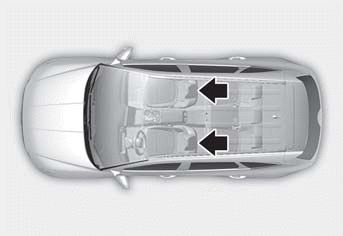
The driver’s and front passenger’s seats are equipped with adjustable head restraint for the passengers safety and comfort.
Adjusting the height up and down
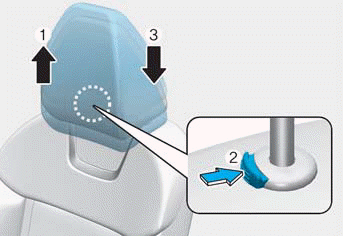
To raise the head restraint:
1. Pull it up to the desired position 1.
To lower the head restraint:
1. Press and hold the release button 2 on the head restraint support.
2. Lower the head restraint to the desired position 3.
Removal/Reinstallation
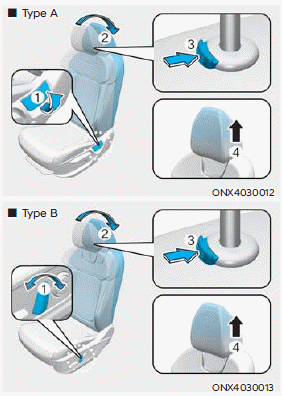
To remove the head restraint:
1. Recline the seatback 2 with the seatback angle lever or switch 1. 2. Raise the head restraint as far as it can go.
3. Press the head restraint release button 3 while pulling the head restraint up 4.
WARNING
Never allow anyone to travel in a seat with the head restraint removed.
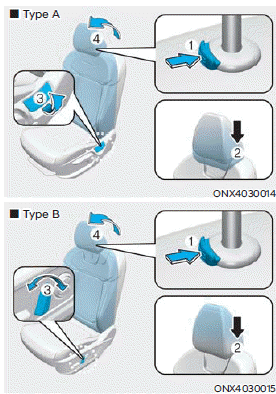
To reinstall the head restraint:
1. Recline the seatback.
2. Put the head restraint poles 2 into the holes while pressing the release button 1.
3. Adjust the head restraint to the appropriate height.
4. Return the seatback 4 with the seatback angle lever or switch 3.
WARNING
Always make sure the head restraint is locked in place and properly adjusted for the passenger.
Rear seat head restraint
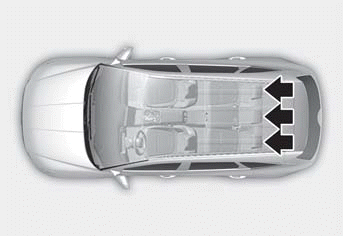
The rear seats are equipped with head restraint in all the seating positions for the passenger’s safety and comfort.
Adjusting the height up and down
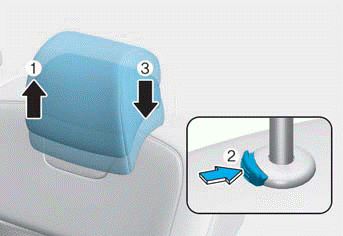
To raise the head restraint:
1. Pull it up to the desired position 1.
To lower the head restraint:
1. Press and hold the release button 2 on the head restraint support.
2. Lower the head restraint to the desired position 3.
Removal/Reinstallation

To remove the head restraint:
1. Raise the head restraint as far as it can go.
2. Press the head restraint release button 1 while pulling up the head restraint 2.
To reinstall the head restraint:
1. Put the head restraint poles into the holes 3 while pressing the release button 1.
2. Adjust the head restraint to the appropriate height.
 Rear Seats
Seatback angle
To recline the seatback:
1. Pull up the seatback recline lever.
2. Hold the lever and adjust the seatback
of the seat to the desired position.
3. Release the lever and make sure ...
Other information:
Hyundai Tucson (NX4) 2022-2026 Service Manual: Description and Operation
- Description
Rear Corner Radar is a system that measures the relative speed and
distance from the following vehicles by using two electromagnetic wave
radar sensors attached to the rear bumper, and detects any vehicle
within the blind spot zone and gives off alarm.System Interface
&n ...
Hyundai Tucson (NX4) 2022-2026 Owner's Manual: Rear Cross-Traffic Collision-
Avoidance Assist Operation
Rear Cross-Traffic Collision-Avoidance
Assist may warn and control your vehicle
depending on the collision risk level.
Collision Warning
To warn you of an approaching vehicle
from the rear left or right of your vehicle,
the warning light on the side view mirror
may blink, a warning mes ...
