
Hyundai Tucson: Air Conditioning System / Condenser
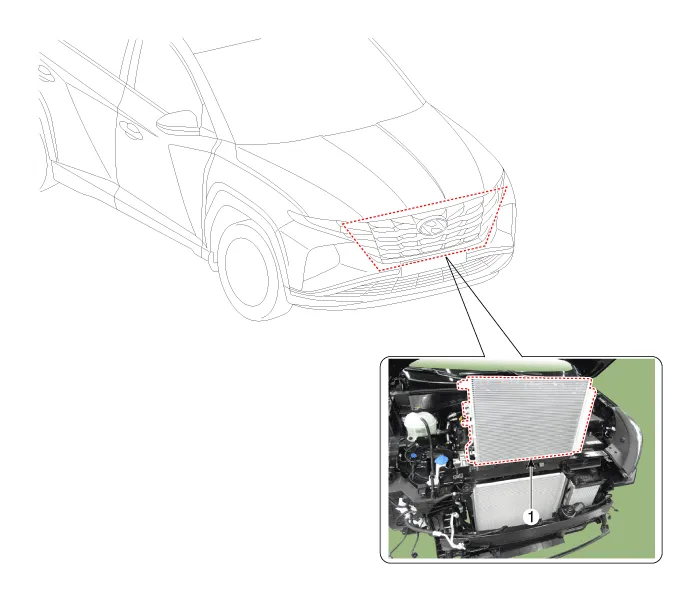
1. Condensor
1.Check the condenser fins for clogging and damage. If clogged, clean them with water, and blow them with compressed air. If bent, gently bend them using a screwdriver or pliers.
2.Check the condenser connections for leakage, and repair or replace it, if required.
1.Recover the refrigerant with a recovery/recycling/charging station.(Refer to Air conditioning System - "Repair procedures")
2.Disconnect the negative (-) battery terminal.
3.Remove the front bumper assembly.(Refer to Body - "Front Bumper Assembly")
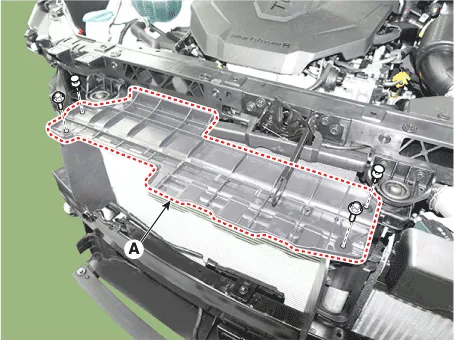
4.Loosen the mounting botls and clips, remove the radiator upper guard (A).
Tightening torque : 3.9 - 5.9 N.m (0.8 - 1.2 kgf.m, 2.9 - 4.3 lb-ft)
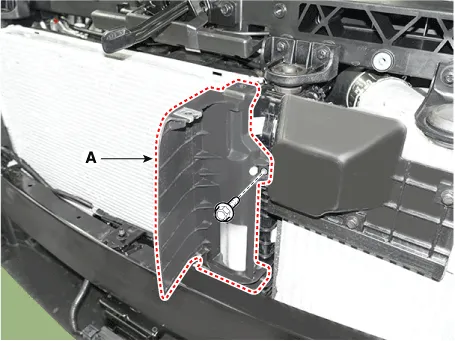
5.Loosen the mounting bolt, remove the upper air guard (A).
Tightening torque : 3.9 - 5.9 N.m (0.8 - 1.2 kgf.m, 2.9 - 4.3 lb-ft)
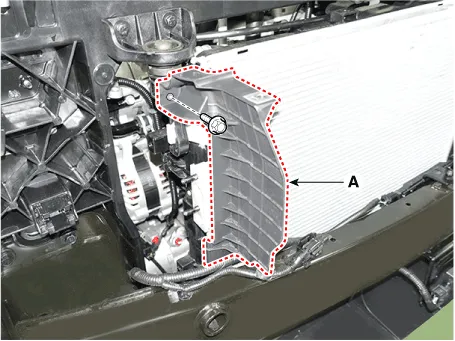
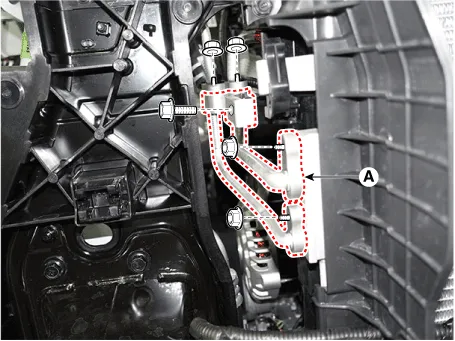
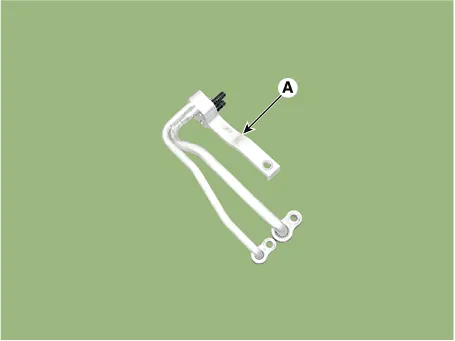
6.Loosen the mounting nuts and separate liquid line (A).
Tightening torque :7.8 - 11.8 N.m (0.8 - 1.2 kgf.m, 5.8 - 8.7 lb-ft)
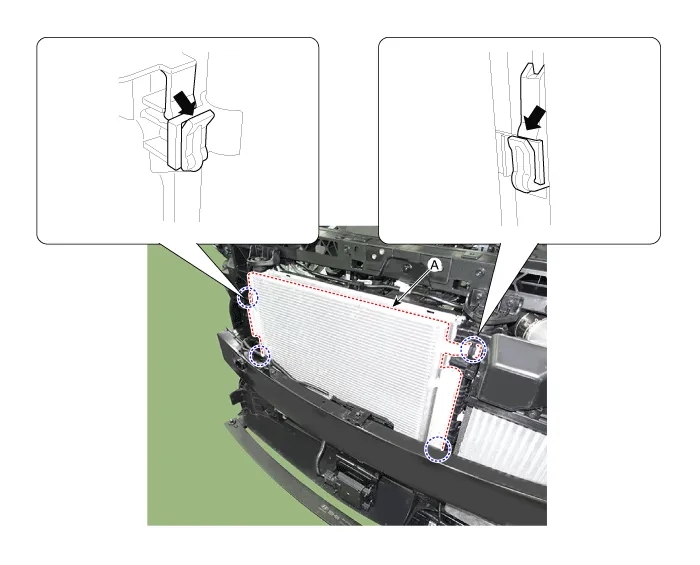
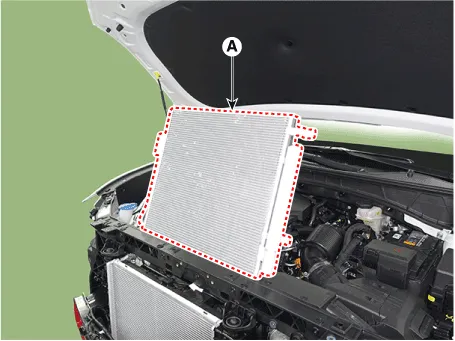
7.Press the lock pin and remove the condenser assembly (A) from radiator assembly.
8.Install in the reverse order of removal.

• If you're installing a new condenser, add refrigerant oil.
• Replace the O-rings with new ones at each fitting, and apply a thin coat of refrigerant oil before installing them. Be sure to use the right O-rings for R-134a or R-1234yf to avoid leakage.
• Be careful not to damage the radiator and condenser fins when installing the condenser.
• Charge the system, and test its performance.
 Compressor
- Description
The compressor is the power unit of the A/C system.It is located on the
side of engine block and driven by a V-belt of the engine.The
compressor changes low pressure and low tempe ...
 Receiver-Drier
- Replacement
1.Remove the condensor.(Refer to Air conditioning System - "Condensor")
2.Using a Lwrench, remove the cap (A) on the bottom of the receiver-drier.
3.Remove the receiver-drier (A) ...
Other information:
Hyundai Tucson (NX4) 2022-2026 Owner's Manual: SRS Care
The SRS is virtually maintenance-free
and there are no parts you can safely
service by yourself. If the SRS airbag
warning light does not illuminate when
the ignition switch is in the ON position
or continuously remains on, have the
system immediately inspected by an
authorized HYUNDAI ...
Hyundai Tucson (NX4) 2022-2026 Service Manual: Fender Garnish
- Replacement
• When removing with a flat-tip screwdriver or remover, wrap protective tape around the tools to prevent damage to components.
• Put on gloves to prevent hand injuries.
1.Using a screwdriver or remover, remove the fender garnish (A).
2.To install, re ...
