
Hyundai Tucson: Engine Control System / Crankshaft Position Sensor (CKPS)
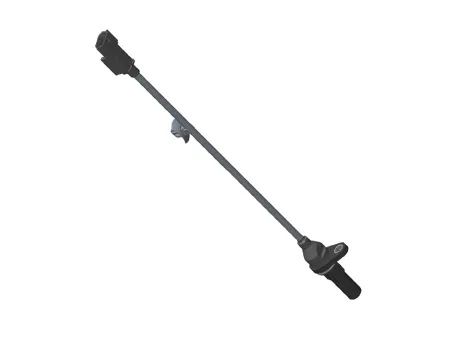
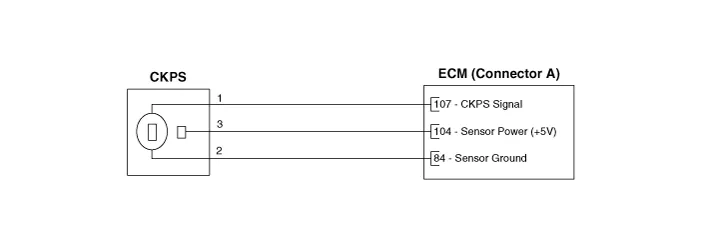
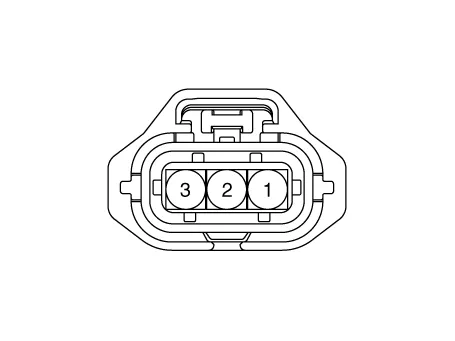
1.In the engine control system, failure can be quickly diagnosed by using the diagnosis tool.
(1)Self diagnosis : Checking failure and code number (DTC).
(2)Current data : Checking the system input/output data state.
(3)Actuation test : Checking the system operation condition.
(4)Additional function : Controlling other features including system option setting and zero point adjustment.
1.Check signal waveform of CKPS and CMPS using a diagnostic tool.
Specification : Refer to "DTC Diagnosis Guide"

• Be careful not to damage the parts located under the vehicle (floor under cover, canister, fuel tank) when raising the vehicle using the lift.(Refer to General Information - "Lift and Support Points")
1.Disconnect the crankshaft position sensor connector (A).
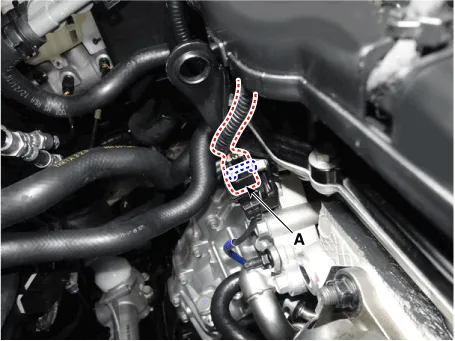
2.Remove the connector (A) from the bracket (B).
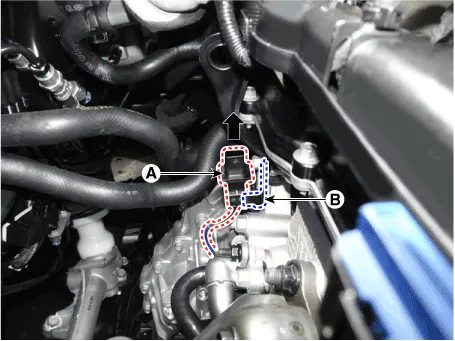
3.Remove the transfer assembly [4WD].(Refer to 4 Wheel Drive (4WD) System - "Front Wheel Transfer Assembly")
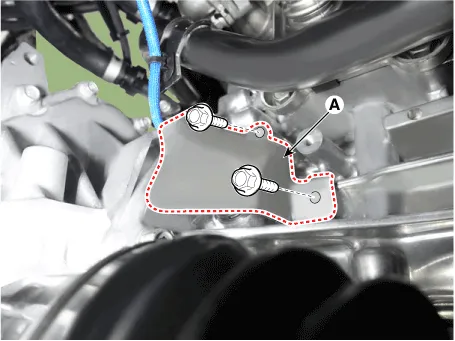
4.Remove the cover (A) after loosening the mounting bolt.
Tightening Torque :9.8 - 11.8 N.m (1.0 - 1.2 kgf.m, 7.2 - 8.7 lb-ft)
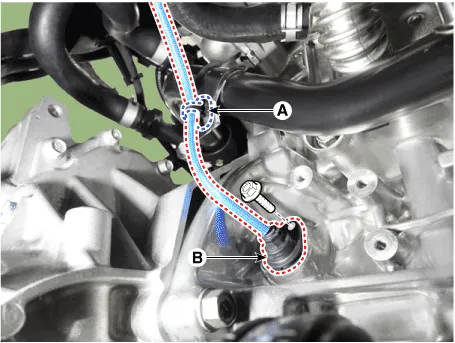
5.Disconnect the wiring fixing clip (A) and then removing the sensor (B) after loosening the mounting bolt.
Tightening Torque :9.8 - 11.8 N.m (1.0 - 1.2 kgf.m, 7.2 - 8.7 lb-ft)

• Install the component with the specified torques.
• Note that internal damage may occur when the component is dropped. If the component has been dropped, inspect before installing.

• Apply the engine coolant to the O-ring.

• Insert the sensor in the installation hole and be careful not to damage.
1.Install in the reverse order of removal.
 Engine Coolant Temperature Sensor (ECTS)
- Description
Water temperature sensor (WTS) is located in the engine coolant passage
of the cylinder head for detecting the engine coolant temperature.The
WTS uses a thermistor whose resistanc ...
 Camshaft Position Sensor (CMPS)
- Description
Camshaft Position Sensor (CMPS) is a hall sensor and detects the
camshaft position by using a hall element.It is related with Crankshaft
Position Sensor (CKPS) and detects the pis ...
Other information:
Hyundai Tucson (NX4) 2022-2026 Service Manual: Components and Components Location
- Component Location
[Fuel Tank]
1. Fuel tank2. Canister3. Vapor hose4. Canister Close Valve (CCV)5. Vent hose6. Fuel filler hose7. Fuel tank air filter8. Fuel Tank Pressure Sensor (FTPS)9. Fuel Level Sender (FLS)10. Fuel pump11. Fuel filter12. Fuel pressure regulator
[High Pressure Fuel Li ...
Hyundai Tucson (NX4) 2022-2026 Owner's Manual: To set vehicle distance
Each time the button is pressed, the
vehicle distance changes as follows:
If you drive at 56 mph (90 km/h), the
distance is maintained as follows:
Distance 4 - about 172 feet (53 m)
Distance 3 - about 130 feet (40 m)
Distance 2 - about 106 feet (30 m)
Distance 1 - about 82 feet (25 m ...
