
Hyundai Tucson: Charging System / Battery Sensor
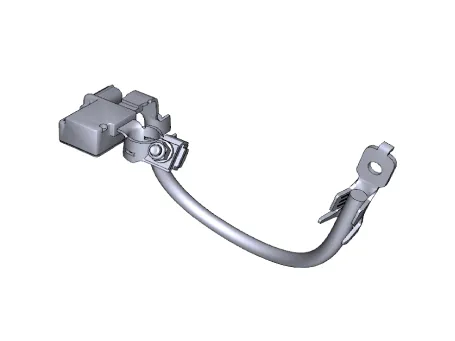
1.Turn the ignition switch OFF and disconnect the battery (-) terminal.
2.Remove the battery.(Refer to Charging System - "Battery")
3.Disconnect the battery sensor connector (A).
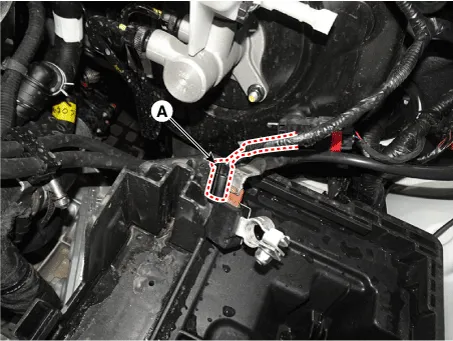
4. Remove the battery sensor (A).
Tightening torque :26.5 - 32.4 N.m (2.7 - 3.3 kgf.m, 19.5 - 23.9 Ib-ft)
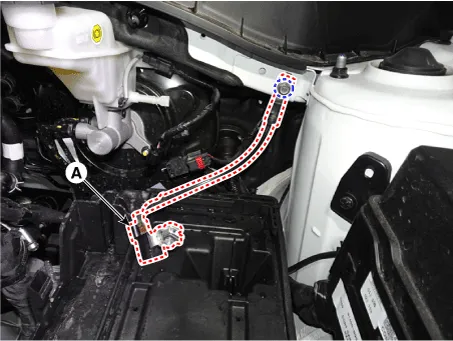
1. Install in the reverse order of removal.

• For the vehicle equipped with a battery sensor, be careful not to damage the battery sensor when the battery is replaced or recharged.
1)When replacing the battery, the new battery should be of the same type, capacity and brand with the previous one. If a battery of a different type is replaced, the battery sensor may recognize the battery to be abnormal.
2)When installing the ground cable on the negative post of battery, tighten the clamp to the specified torque. An excessive tightening can damage the PCB internal circuit and the battery terminal.
3)When recharging the battery, ground the negative terminal of the booster battery to the vehicle body.
1.Turn the Iginition switch ON and OFF.
2.Park the vehicle for about 4 hours with the hood and all doors closed.
 Battery
- Description
CMF Battery
The CMF (Closed Maintenance Free) battery is, as the name implies,
totally maintenance free and has no removable battery cell caps.The CMF
(Closed Maintenance Free) b ...
 DC DC converter
- Description
Due to the considerably more frequent occurrence of starting
operations, the electrical load that occurs often leads to voltage dips
in the vehicle network.In order to stabilize t ...
Other information:
Hyundai Tucson (NX4) 2022-2026 Service Manual: Description and Operation
- Description
Power liftgate is an electro-mechanical system designed to provide
power opening and closing of the liftgate through the push of a button
of a remote key (fob), console switch, inner switch or an outside handle
switch of the liftgate.The power liftgate will reverse direction o ...
Hyundai Tucson (NX4) 2022-2026 Service Manual: Differential Carrier Assembly. Rear Differential Carrier
Rear Differential Carrier
- Components Location
1. Rear differential carrier assembly2. Rear driveshaft assembly3. Coupling Assembly4. Propeller shaft assembly
- Components
1. Pinion lock nut2. Oil seal (pinion side)3. Pinion outer bearing4. Oil seal (case side)5. Packing6. Drain plu ...
